A guide
Tiles last decades. Silicone doesn't.
A bathroom is the wettest, most temperature-swung room in the house, and almost everything that goes wrong in the first few years is preventable. None of this is complicated, and none of it needs a specialist product. It is the advice Paul gives at hand-over, written down.
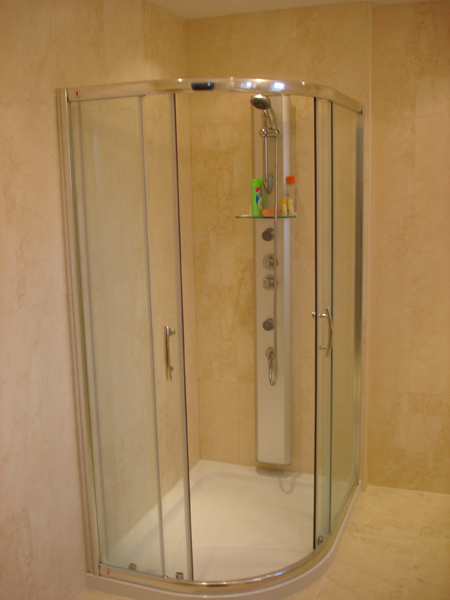
01
The first week
Give the silicone its time
Fresh silicone skins over in an hour but is not fully cured for around 24 hours, and grout wants longer than that before it gets properly wet. Paul will tell you at hand-over when the shower can be used — resist the urge to try it the same evening.
Don't scrub anything yet
Grout haze on new tiles lifts with a dry microfibre cloth and a little warm water. Abrasive cream cleaners and scouring pads on week-one grout will take the surface off it and leave a patch you can see forever.
Run the extractor
Use the fan from day one, and leave it running for a while after the shower rather than switching it off as you step out. Most fans are wired to overrun for exactly that reason.
02
Week to week
Squeegee the glass
Thirty seconds with a squeegee after a shower does more for a screen than any spray. What makes glass go cloudy is limescale from dried droplets, and the West Midlands water supply is hard enough to leave it every time.
Mild and neutral beats strong
Washing-up liquid in warm water cleans almost everything in a bathroom. Bleach and strong acidic descalers attack grout, silicone and the finish on brassware — especially the brushed and matt black finishes, which are surface treatments rather than solid metal.
Wipe the shower tray edges
The junction between tray and tile is where the room tells you first that something is wrong. Keep it clean and you will notice a lifting corner of silicone months before it becomes a leak.
03
Once or twice a year
Check the silicone, all of it
Bath, tray, basin, and the internal corners. Silicone is a consumable, not a permanent fixture — it takes movement so the tiles do not have to, and it is meant to be replaced every few years. Doing it before it fails costs a tube and an afternoon; doing it after costs a floor.
Clear the trap and the waste
A slow basin or a slow shower is nearly always hair and soap in the trap, not a problem with the pipework. Ten minutes with a bucket saves a call-out.
Look at the ceiling
Black spotting above the shower means the extraction is not keeping up, or the fan has partially blocked. Both are cheap to fix at that stage and expensive to ignore.
04
Things worth ringing about
A tile that sounds hollow
Tap along a wall with a knuckle. A tile that rings hollow has lost its bond and will eventually crack or lift. Caught early, it is one tile.
Grout going dark in a line
Discolouration following a joint, rather than general grubbiness, usually means water is tracking behind. That is worth looking at quickly.
A shower that has lost pressure
Often a blocked head or filter rather than anything structural — but if it came on suddenly and the rest of the house is fine, it is worth a look.
Aftercare is part of the job, not an extra
Paul deals with anything that needs attention after a job himself — you do not get passed to an office. If something in a bathroom he fitted does not look right, ring 0121 706 5715 and tell him about it.
Thinking about the bathroom?
Ring or text Paul, or send a couple of photos and rough measurements by email. He will come out, look at the room and price it properly — the visit is free and there is no obligation at the end of it.
Paul is usually on the tools, so leave a message or a text and he rings back himself — you never get passed to a call centre.